

The college teaching load in its many forms

16 octobre 2026
The college teaching load in its many forms
If anyone can confirm whether or not sociology is a martial art (a form of intellectual self-defence), as Pierre Bourdieu once put it, it is two professors from the Cégep de Sainte‑Foy. For over two years now, Edith Pouliot and Karine Moisan have been undertaking a monumental task: conducting a methodological study of the college teaching profession.

“It all began the day after the last round of negotiations, when several members of our union expressed disappointment at the content of the agreement. The lack of significant gains in relation to the teaching load – that is, the core of our work – was what started it all”, the two colleagues recall. President of the Syndicat des professeures et professeurs du Cégep de Sainte-Foy at the time, Edith Pouliot threw herself into the project and teamed up with Karine Moisan, who is known for her expertise in statistical analysis.
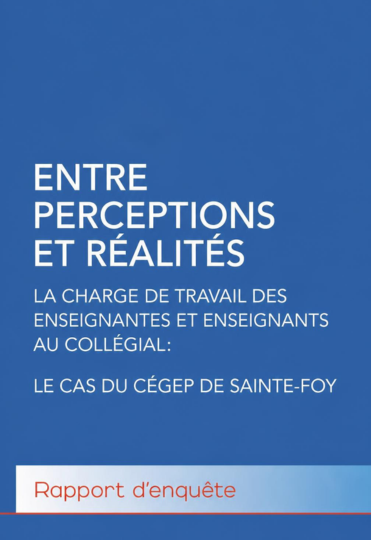
Many hours of gruelling work went into the recent publication of the extensive research report entitled “Entre perceptions et réalités : la charge de travail des enseignantes et des enseignants au collégial” (Between perceptions and reality: the teaching loads of college professors). “Besides the standard literature review involved in this kind of research, retracing the history of the provisions in our collective agreements was clearly the hardest part! It is already difficult to fully understand exactly what, under our collective agreement, constitutes an individual teaching load, commonly referred to as ‘CI’ (charge individuelle), but tracing its evolution from one bargaining round to the next was even more complicated”, explained Edith Pouliot.
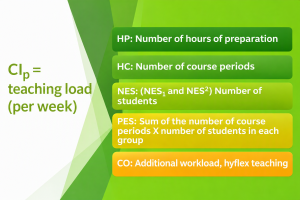
If you don’t recognize this formula, it’s because you haven’t read appendix VIII-1 of your collective agreement! It is, in fact, the formula that defines how professors’ teaching loads are to be calculated. In short: it is much more complicated than you may think.
The formula aims to distribute the resources available for the teaching load as evenly as possible while taking into consideration the fact that not all professors exercise their profession in the same conditions: class sizes may vary, as do number of course preparations, supervision of internships, departmental coordination, etc.
“When you first join the network, they tell you, ‘Here you go. You have a CI of 40.’ That means that you have to prepare for such and such course and then, you’re ready to go… and, above all, good luck”, Karine Moisan says with a hint of sarcasm. “Then, you realize that you’re actually lucky to have a CI of 40 because it means you’re full time. But later, from one semester to the next, as other obligations are piled on, you begin to understand the calculations and then, really question them: how is the relative weight of my 140 students calculated? Or how are the preparations for my seven courses or my roles in the different committees calculated?”, she explains. The unions have even felt the need to make an online CI calculator available to their members to help with the calculations. Bargaining rounds are a perfect time to question the model, which is precisely why it has evolved over time, as the survey shows.
How familiar are you with article 8-3.00?
Prior to the 1980s, teaching loads were calculated by the number of work hours. However, the draconian decree imposed by the Parti Québécois in 1983 converted the formula into units of CI and increased professors’ workloads at the same time. Despite some improvements to “make up for lost ground” in the following bargaining rounds, the authors of the report noted that “most changes made to the CI calculation formula over time were aimed at regulating workloads to avoid excesses (too many students or too many different course preparations), and not at lightening the overall workload for the teaching staff as a whole” (p. 14). Before we discuss the causes of the heavier workload, it is important to mention – at the risk of losing everyone who has read this far – a few key aspects of the terms and conditions set out in our collective agreement.
The “famous” article 8-3.00 describes the teaching load in detail. It is divided into two sections: the first outlines professors’ core duties (preparation, teaching, supervision, corrections, etc.) in ten points, as well as participation in pedagogical days and departmental meetings. Section 2 specifies other tasks that professors may also be required to perform in certain circumstances (sometimes with release time, sometimes without): departmental or programme coordination, participation in committees, professional development, internships, institutional development, research, etc.
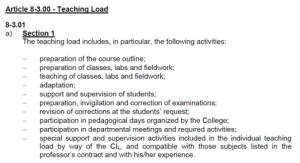
In the early 2000s, in exchange for recognition of step 20 of the salary scale, a clause was added to define certain terms and conditions linked to the recognition of time worked. “The spirit of this agreement was to recognize the full extent of our workload and work hours by including collaborative school life activities inherent in the programmes and pedagogical activities. Its implementation caused some confusion about the assessment of our teaching load”, Edith Pouliot said. “Our teaching load is calculated on the basis of CIs, whereas the recognition of time worked is measured in hours. We are asked to dedicate 173 hours per year to these activities, such as student support and supervision and improving success rates, even though many of these tasks are already part of our ‘normal’ teaching load.”
“To make matters even more complex, although we are not paid by the hour, our collective agreement refers to a 32.5 hour-period of availability”, Karine Moisan stated. As you will see in the survey report, this is a serious issue that should be raised to clarify and thus improve teaching conditions for college professors. This is all the more necessary as new challenges are constantly emerging in their work environment.
From the 2008 report on the teaching profession to today: two decades of change
“The adoption of various policies, the programme-based approach, the local development of competency-based programmes, the sector’s concern about students’ learning, the growing emphasis on student success and the demand for a higher-skilled workforce all affect professors’ work”, according to the report published in 2008. Entitled Enseigner au collégial : portrait de la profession enseignante (Teaching at the colleges: a portrait of the teaching profession), this joint (employer-union) report had already observed the increasing complexity and weight of the workload, brought on by the implementation of the Robillard reform.
In addition to these changes to teaching work, namely the decentralization of programme development, there are several other factors that have had significant impacts and that have grown in importance. Particularly noteworthy are the increase in the number of students with disabilities (EESH), which is now seven times higher than in 2007; the pressure to ensure student success and engage in institutional development, and the diversification of the profiles of the student population in general. More recently, broad public access to artificial intelligence has added an extra layer to the existing digital and pedagogical challenges, especially in relation to student evaluations and plagiarism.
As the two sociologists managed to confirm after surveying hundreds of professors at Cégep de Sainte-Foy, these changes are not without consequences. “While our colleagues say they appreciate several aspects of their work, such as flexibility, 85% of respondents say they do not have enough time to carry out their tasks in a satisfactory way, and nearly 80% state that they feel overworked. This is a major concern for us.”
|
Quote from the discussion groups |
| “As we’re constantly juggling several related tasks, it’s as though we’re unable to refine our courses the way we’d like… when you are always rushing around to deal with all sorts of other matters, it seems like you don’t have time to do your main job, which is to be a prof”. |
To obtain proof of this, the two professors requested information from management on absences and the use of the voluntary working time reduction programme (PVRTT). The data revealed an increase in the cases of disability leave for psychological reasons and the use of the PVRTT. They also noted that use is higher among women. “This programme is undoubtedly used as an individual coping strategy, for want of better options, and especially to help with the family-work balance from one semester to another. But this individual strategy comes at a personal cost”, affirmed Edith Pouliot, the current vice-president of the FEC-CSQ.
These concerns about the psychosocial impacts of excessive workloads are present throughout the research report and reflect the growing collective awareness on this issue. Sonia Lupien’s book Le stress au travail vs le stress du travail (stress at work vs work stress) was published just as they were beginning their survey. The neuroscience researcher’s work is focussed on drawing attention to the harmful effects of current work practices. Lupien demonstrated how deep work is increasingly difficult to do in a digital world where competition for our attention is fierce.
From prescribed work to real work: highlighting inconsistencies and the teaching load
One of the most insightful aspects of the report is the light it shines on the gap between what the collective agreement provides for and the work that profs are actually required to do on a daily basis. Based on a questionnaire of 86 questions completed by 238 respondents and five discussion groups, the study did not merely identify vague feelings of discontent: it documented concrete forms of work overload. What the data show, first and foremost, is that many professors know little about the formal architecture that defines their teaching load.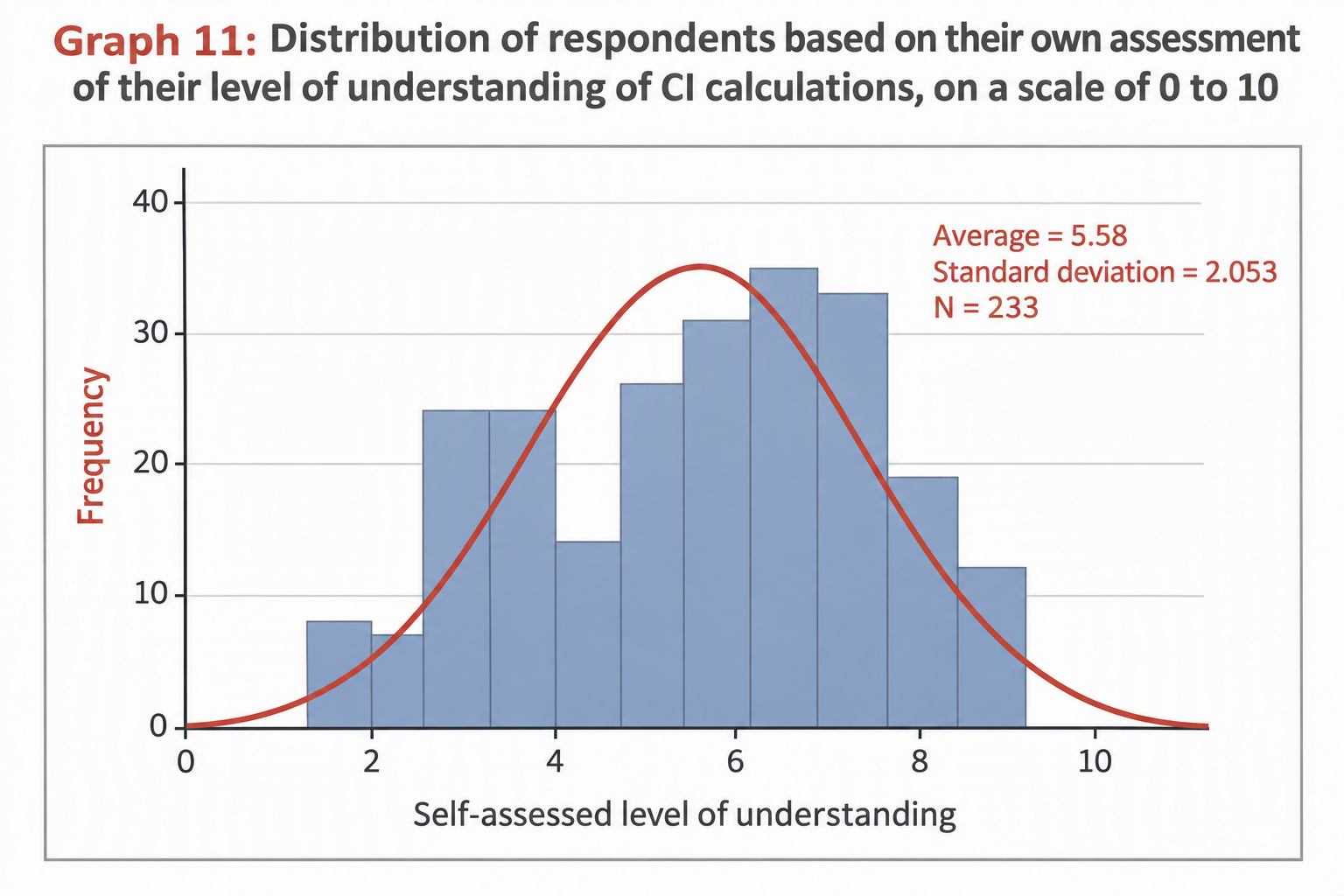 “In general, we know how many CI we have, how many courses we give and how many students we support and supervise, but we know a lot less about how section 1, section 2, the 173 hours, 32.5 hours of availability and institutional expectations that are added on actually fit together.” This lack of clarity is not a minor detail: it adds to the uncertainty about an already heavy teaching load and helps shift the responsibility of managing the extra work to individuals.
Using the most well-known figure in the network as a reference, which is the 32.5 hours per week printed on professors’ payslips, the authors estimated the amount of overtime actually worked at around ten hours a week. This overtime is not something that happens every once in a while: professors are spending their evenings and weekends working, shortening their holidays, adopting emergency strategies to “keep on going” and repeatedly finding themselves in a situation where they are unable to devote the necessary time to the core of their profession. More than three out of four say that they are both overworked and exhausted, while a large majority affirm that they do not have enough time to perform their duties in a satisfactory way.
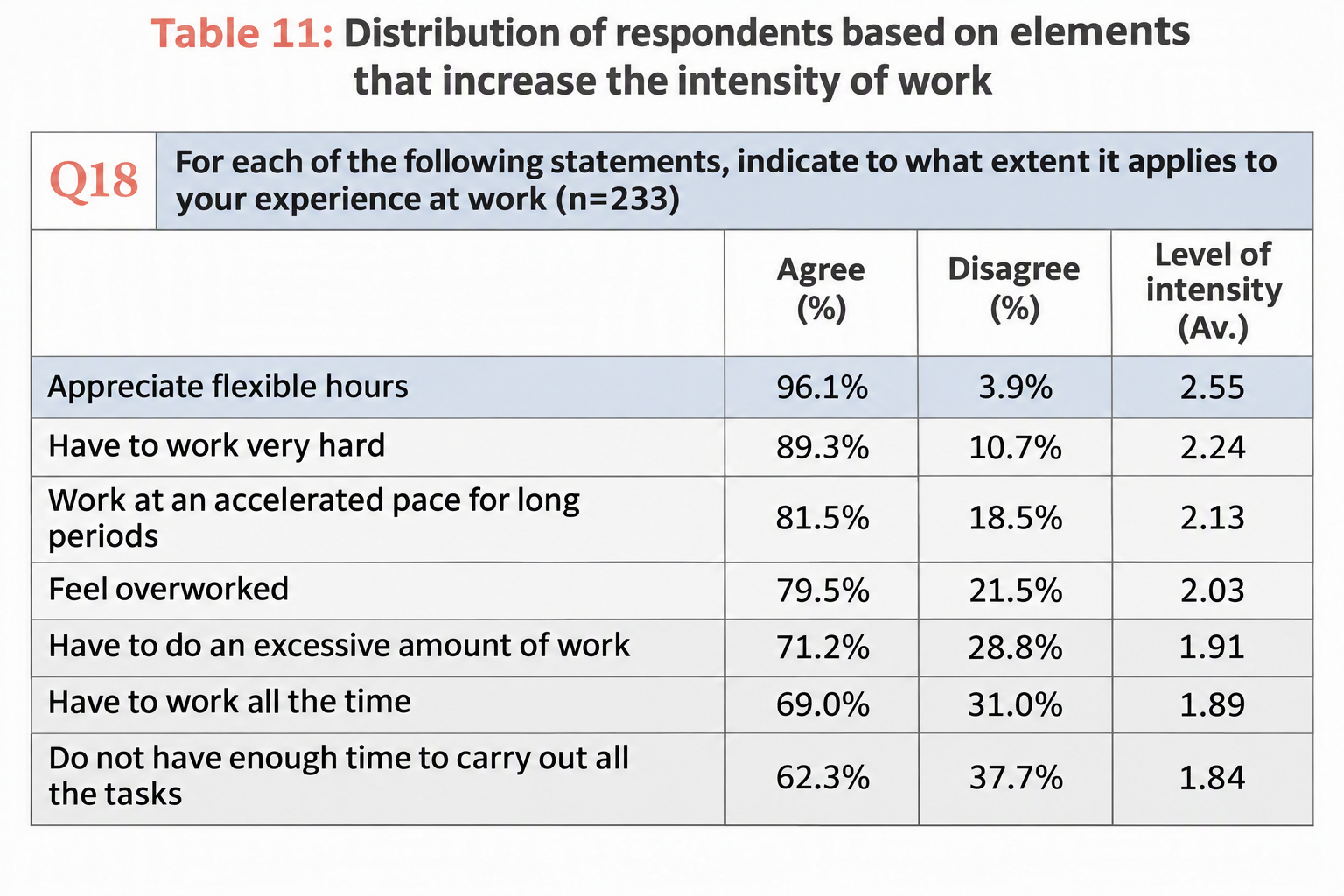
“The first things professors rush through are not just the secondary tasks, but quite often preparation, pedagogical analysis, one-on-one support or teamwork with colleagues – everything that gives meaning to the profession”, the two colleagues observed.
As we highlighted earlier, the survey also shows that this excessive workload is the result of not only the sheer volume of tasks, but also the significant changes to teaching work. To the CI’s historical parameters have been added – without conducting a proper review – the 173 hours-burden; the proliferation of committees; programme updating and implementation cycles; pressure to respond immediately generated by emails, digital platforms and artificial intelligence, as well as a more diversified student population’s growing need for support and supervision.
“This all leads to the fragmentation of our work, as we continually go from one demand to the next, from one emergency to another, which encourages overworking – that is, the inability to set boundaries at work and its encroachment into our personal lives. And as our data clearly show, the strategies used to deal with this overload are often individual: read fewer documents, postpone certain tasks, cut back on personal time or request a PVRTT to stay afloat”, Karine Moisan and Edith Pouliot clarified. And that says a great deal about the situation: when the way that work is organised pushes people to find ways to make adjustments on their own, it is no longer simply a matter of professional discontent, but rather collective issues concerning psychological health, organisational justice and the meaning of work. The CSQ’s “It’s not in your head” campaign illustrates these issues well.
From observations to action: in preparation for the next round of negotiations
This report enables us to contest a discourse that suggests that suffering at work is mainly a personal stress management problem. The survey’s findings call for a collective and political response. What appears repeatedly throughout the report is that work overload is not limited to a few isolated cases; the overall organisation of work is ill-adapted to the current reality of college teaching. The survey does more than document a problem: it offers concrete points of discussion for the next bargaining round and for local actions at the Cégeps, starting immediately.
Among the courses of action identified, one stands out: clarify the shared understanding of what is included in the teaching load. This involves reviewing how tasks are defined and distributed among section 1, section 2 and the 173 hours; limiting the flexibility of the latter, and better ensuring time for deep pedagogical work. Because if things can always be added in the name of innovation, collaboration or ongoing improvements, then where’s the limit? The report calls for a more comprehensive review of the portrait of the teaching profession, which has not been the subject of a joint effort since 2008, even though teaching conditions have been dramatically altered by the diversification of the student population, the digitalisation of work and the increase in reporting requirements and new institutional demands.
In the end, one of the biggest contributions of this study is to remind us that defending the teaching load means defending the minimum conditions needed to teach properly. Reduce fragmentation, safeguard spaces where professors can disconnect and concentrate, replace individual adjustments with collective solutions, give greater recognition to related tasks and revisit the formula for CI, which is no longer adapted to the reality of professors at work: these are all issues that can mobilize union action in the future. “Although it took a lot of hard work, by bringing to light what many professors are currently going through, we hope that our work will help refocus discussions on the heart of the profession, which is the quality of teaching. It is the very essence of our profession”, the two professors concluded.